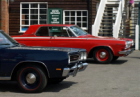
Rob & Stu's 63 Polara 500
Moderator: Moderators
Thanks guys, and Sandy
give us a break!!
Anyway, where was I.....
So, with the timing checked, all sensors attached, super unleaded topped up, we were ready to check the temporary induction set-up, hoping the even-more-temporary valley gasket would hold out for at least one decent pull. We added another rocker cover gasket to each side to raise the covers above the thicker flanges on the Indy inlet. So the extra worry of oil leaks added to the (mine, at least) tension!
Bearing in mind the engine hadnt seen more than about 3000 revs up to now, Kenny limited the 1st run to 4900 rpm. Timing was kept at a conservative 32deg and no tinkering had been done to the Holley. Ken just knew it would work well enough to check the problem we were having.
Well, as you might imagine, the carb, inlet & Bodgit & Scarper valley pan cover, performed admirably and let the engine pull nicely up to the imposed rev limit.
What's that? You want numbers?
Test 1 - 423hp @ 4900rpm, 455lb-ft @ 4400
With no drama on that pull, we went for another tentative 100rpm and saw
Test 2 - 431hp @ 5000rpm, 459lb-ft @ 4600
So went hell for leather on the 3rd and final run of the day, and stuck it on 5500
Test 3 - 450 @ 5400 (started tailing off at 5500 with 448hp), 457 lb-ft @ 4900
After the 1st test we knew the Carters were causing the problem, so we just did the 2nd & 3rd run because it would be rude not to
We knew not to read too much into the figures with this Holley/Indy set-up, but we were all pretty chuffed with the numbers achieved, considering:
1. the headers on the dyno are over 2" and probably hurting the torque figures and curve - 1-3/4" headers would prob give a better result. Having said that, we're not planning to use headers, but the original cast iron manifolds. Kenny reckons a good set of headers will give you about 70hp over stock cast iron manifolds, but we hope our swoopy max wedge jobbies will be somewhere in between. We'll take them up next time we go to see what difference they do make.
2. Carb & inlet were not adjusted/jetted or matched to the cam/compression etc of the engine as Paul had built it.
3. We stuck to 32deg timimg for this test, so expect to wring a bit out of her with a bit more timing.
4. With the above rectified, using a few more revs might yet see an improvement?
And dont forget this was always intended to be a rebuild to (pretty much) stock specs so as long as we're on the right side of 410hp, we'd be happy
By now it was gone 8.30 and we'd already stopped Kenny from going to a car show in Wakefield (Bill Billadeau had gone there in the ex-Pete W Challenger), so had a quick discussion where to go from here with the rebuild & dyno test, and were away at around 9pm.
As the Carters had already been rebuilt with new gaskets etc before the trip oop to EDA, and we had already tried some adjustments/tuning earlier in the day, all we could think was that some septic (tank, geddit?) over the years before we got the car had been a bit brutal with some d.i.y. tuning an had buggered
some hard-to-see parts like the emulsion tubes.
Without knowledge of any Carter experts that could solve the mystery, we resigned ourselves to the fact that we may need to get a pair of new Edelbrocks that are commonly used as a replacement. Not quite in keeping with our plan of keeping it all as stock as possible, but what can you do ?!
That's how we left it with Kenny & Paul as we departed Friday night. Kenny was going to get in touch with the UK & European Edelbrock rep to see what was available on Sat am.
I spoke to Paul this morning though, and after a night's sleep, had another suggestion for Kenny to try on Monday to see if he can get the poor old Carters' primaries working.
And that's where we are with it at the moment !
Whatever the outcome is, weve got to say a BIG thanks (whether they're looking in or not) to Paul & all at EDA for their help in this. Granted, they're being paid as it's part of their job, but Kenny was more than happy to stay on till we reached a conclusion, and is keen help us to a solution in any way he can.
And Paul was jet-lagged to the gills after coming back from his hols on Tuesday, driving up to Castleford Thurs evening, over to Dave B's Friday evening, then home Friday night.
And thanks again to Dave B.
So a big
to all involved.
Just a shame the Nats is looking doubtful now
Anyway, where was I.....
So, with the timing checked, all sensors attached, super unleaded topped up, we were ready to check the temporary induction set-up, hoping the even-more-temporary valley gasket would hold out for at least one decent pull. We added another rocker cover gasket to each side to raise the covers above the thicker flanges on the Indy inlet. So the extra worry of oil leaks added to the (mine, at least) tension!
Bearing in mind the engine hadnt seen more than about 3000 revs up to now, Kenny limited the 1st run to 4900 rpm. Timing was kept at a conservative 32deg and no tinkering had been done to the Holley. Ken just knew it would work well enough to check the problem we were having.
Well, as you might imagine, the carb, inlet & Bodgit & Scarper valley pan cover, performed admirably and let the engine pull nicely up to the imposed rev limit.
What's that? You want numbers?
Test 1 - 423hp @ 4900rpm, 455lb-ft @ 4400
With no drama on that pull, we went for another tentative 100rpm and saw
Test 2 - 431hp @ 5000rpm, 459lb-ft @ 4600
So went hell for leather on the 3rd and final run of the day, and stuck it on 5500
Test 3 - 450 @ 5400 (started tailing off at 5500 with 448hp), 457 lb-ft @ 4900
After the 1st test we knew the Carters were causing the problem, so we just did the 2nd & 3rd run because it would be rude not to
1. the headers on the dyno are over 2" and probably hurting the torque figures and curve - 1-3/4" headers would prob give a better result. Having said that, we're not planning to use headers, but the original cast iron manifolds. Kenny reckons a good set of headers will give you about 70hp over stock cast iron manifolds, but we hope our swoopy max wedge jobbies will be somewhere in between. We'll take them up next time we go to see what difference they do make.
2. Carb & inlet were not adjusted/jetted or matched to the cam/compression etc of the engine as Paul had built it.
3. We stuck to 32deg timimg for this test, so expect to wring a bit out of her with a bit more timing.
4. With the above rectified, using a few more revs might yet see an improvement?
And dont forget this was always intended to be a rebuild to (pretty much) stock specs so as long as we're on the right side of 410hp, we'd be happy
By now it was gone 8.30 and we'd already stopped Kenny from going to a car show in Wakefield (Bill Billadeau had gone there in the ex-Pete W Challenger), so had a quick discussion where to go from here with the rebuild & dyno test, and were away at around 9pm.
As the Carters had already been rebuilt with new gaskets etc before the trip oop to EDA, and we had already tried some adjustments/tuning earlier in the day, all we could think was that some septic (tank, geddit?) over the years before we got the car had been a bit brutal with some d.i.y. tuning an had buggered
Without knowledge of any Carter experts that could solve the mystery, we resigned ourselves to the fact that we may need to get a pair of new Edelbrocks that are commonly used as a replacement. Not quite in keeping with our plan of keeping it all as stock as possible, but what can you do ?!
That's how we left it with Kenny & Paul as we departed Friday night. Kenny was going to get in touch with the UK & European Edelbrock rep to see what was available on Sat am.
I spoke to Paul this morning though, and after a night's sleep, had another suggestion for Kenny to try on Monday to see if he can get the poor old Carters' primaries working.
And that's where we are with it at the moment !
Whatever the outcome is, weve got to say a BIG thanks (whether they're looking in or not) to Paul & all at EDA for their help in this. Granted, they're being paid as it's part of their job, but Kenny was more than happy to stay on till we reached a conclusion, and is keen help us to a solution in any way he can.
And Paul was jet-lagged to the gills after coming back from his hols on Tuesday, driving up to Castleford Thurs evening, over to Dave B's Friday evening, then home Friday night.
And thanks again to Dave B.
So a big
Just a shame the Nats is looking doubtful now
Last edited by RobTwin on Tue Jul 11, 06 1:06 am, edited 1 time in total.

Well done and great write-up Rob, these things are sent to try us eh!!!!
Better to find out that kind of stuff on the dyno though, sounds like you are getting to the root of the prob....hope you are back on the road for the Nats!
Gavin Chisholm - 414ci W2 Stroker SmallBlock Panther Pink '71 Challenger convertible - in bits
Car progress can be viewed here
- Dave-R
- Posts: 24752
- Joined: Sun Apr 18, 04 11:23 pm
- Location: Dave Robson lives in Geordieland
- Contact:
A high volume pump does not effect oil pressure as far as I know? It is the spring in the oil pump that sets the pressure level.RobTwin wrote:One symptom that suggested it may not be just a carb problem, was that there were some soot marks appearing around the air bleed holes on one of the carbs, which Dennis thought might be something to with the high vol oil pump fitted. Den said you shouldn't use a high vol oil pump with a hydraulic cam (tho Paul, Kenny & Koffel that sold the pump said it should be ok), and as the pressure was over 80 psi at less than 3000rpm, thought oil may be pumping up (sorry if thats the wrong term!) the lifters and causing the valves to let the spent gases back thru the inlet and back thru the carb. To see if the high pressure was causing the flat/lean spot, we changed the oil pump spring for a weaker one. This dropped the psi down by about 30 on the next run but didnt eliminate the flat spot, so swapped the spring back and set about thinking what to do with the carb/inlet problem![]()
It certainly don't think it would cause reversion back through the intake and carb which is what you are describing.
For those that don't know what reversion is;
Reversion happens at TDC on the exhaust stroke in engines with a restrictive exhaust system or too much camshaft advance.
At TDC on the exhaust stroke both valves are momentarily open. The exhaust is just closing and the intake it just opening. This is called valve overlap. The bigger the cam the bigger this valve overlap is and the wider open the valves are.
If your exhaust system is restrictive there will still be a fair amount of exhaust pressure in the cylinder when the intake valve opens. This sends a pulse of exhaust gas up the intake runner and out of the carb. Reducing vacuum and you actually get black soot building up on the inside of the carb. The gas dilutes the air/fuel mixture and makes the engine detonate (pink) more easily too.
A intake valve that opens early has the same effect. The bigger the cam the sooner the intake valve opens. Advancing the cam makes this worse because not only does the intake valve open sooner but the exhaust closes later.
The way to reduce or remove reversion is to let the exhaust valve stay open longer and delay the opening of the intake valve. Another way is to fit a very low restriction exhaust system.
In this case I don't know what the cause was but I doubt a high volume oil pump would pump the lifters up and hold the valves open. If the pushrods are the correct length you would get very little or no valve float anyway because the lifters can only pump up as far as the circlip holding them together. For this reason I usually use lifters with a real circlip in the top (not the stock thin wire) and only preload them about 20 thou. Some racers run with zero lash and no preload at all so it is impossible to get lifter pump up.
Also having the correct valve springs for the cam is critical.
But having said all that it did seem to have very high pressure for the rpm didn't it?
Gavin Chisholm - 414ci W2 Stroker SmallBlock Panther Pink '71 Challenger convertible - in bits
Car progress can be viewed here
- Dave-R
- Posts: 24752
- Joined: Sun Apr 18, 04 11:23 pm
- Location: Dave Robson lives in Geordieland
- Contact:
To be honest. Having recently worked on yet another engine built by a certain "expert" yorkshireman, and the last one dyno'd at this place, I would never go near either. There were some very obvious faults that should have been easily soptted. Like the fact the dizzy was jammed and not advancing at all.....
The oil pressure will be adjusted by changing the spring next time we get on the dyno. May go back to the original spring, tho without an oil pressure gauge in the car (methinks we could do with one now
), dont really know what pressure it gave before.
Once we've got the carbs sorted, we can see if the 'soot' problem is still there.
The good news (at last
) is that whatever Paul suggested to Kenny to try today (he didnt go into too much detail with me
), has resulted in some improvement. At least, enough to eliminate some of the flat spot and give them the chance to try the old metering rods & springs back in the carbs to get some sort of baseline to test from. As far as I know (I'll find out more on Wed I hope), it was something that had been assembled incorrectly in the carbs since before we got the car.
A quick blast on the dyno with the Carters & cross-ram back on, still at 32deg, saw 500lb-ft - thats a 40lb-ft improvement over the 4bbl set-up
What's holding up further progress now is we need another Edelbrock Calibration Kit to continue trying different springs, metering rods, jets etc, to get them to their optimum setting. Kenny reckons we're 85% there, so would be a shame not to get it finished off properly.
Trouble is, we go the only 2 kits in the country last week (1 of which is not a full kit
), and we need another to get a full set of parts for 2 carbs.
By the time we get that and another gasket set it may still be too late for t'Nats
Once we've got the carbs sorted, we can see if the 'soot' problem is still there.
The good news (at last
A quick blast on the dyno with the Carters & cross-ram back on, still at 32deg, saw 500lb-ft - thats a 40lb-ft improvement over the 4bbl set-up
What's holding up further progress now is we need another Edelbrock Calibration Kit to continue trying different springs, metering rods, jets etc, to get them to their optimum setting. Kenny reckons we're 85% there, so would be a shame not to get it finished off properly.
Trouble is, we go the only 2 kits in the country last week (1 of which is not a full kit
By the time we get that and another gasket set it may still be too late for t'Nats